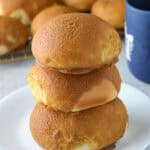
Coffee Buns
Coffee buns are pillowy soft bread with a chewy-crisp coffee coating, and a buttery crumb inside. You will love every bite!
Servings 12 pieces
Calories 334kcal
Equipment
- 1 Pastry bag
- 1 Piping Tip Medium round tip
Ingredients
Bread Dough
- 2¼ teaspoons active dry yeast
- ¼ cup warm water 105-115℉
- 5 tbsp sugar
- ⅔ cup warm milk
- 1 large egg
- ½ tsp salt
- 3 tbsp softened butter
- 3 cups all-purpose flour
The Butter Filling
- ½ cup butter cut 12 into little cubes, then frozen
The Coffee Coating
- 5 tsp instant coffee granules
- 1 tbsp hot water to dissolve the coffee granules
- ¼ cup sugar
- ¼ cup softened butter
- 1 large egg
- ½ cup all-purpose flour
Instructions
- Proof the Yeast and Add the Initial Dough Ingredients. In the bowl of a stand mixer, add the warm/hot water. Sprinkle the yeast and about 1 teaspoon of the sugar. Let this sit for about 5-10 minutes, or until foamy. Add the remaining sugar, milk, the egg, salt, and the softened butter. Stir everything with a rubber spatula or wooden spoon.
- Add the Flour. Add half of the flour, and stir to incorporate. Add the remaining half of the flour and stir until a loose, shaggy ball of dough is formed.
- Knead the Dough. Attach the dough hook to the stand mixer, and knead the dough starting on low speed then speeding up to medium high until the dough starts to gather in the center, and is cleaning the sides of the bowl.
- Window Pane Test. If the dough is still sticky and moist here, sprinkle up to ¼ of flour extra and keep kneading until the dough is smooth, and is cleaning the sides of the bowl. To test, take a little ball of dough in your hand and stretch it out very thinly with your fingers. A translucent film should form in the center. If it doesn't and if the dough tears easily, knead it some more.
- First Rise. Shape the dough into a big ball, place it back on the bowl and cover with a clean kitchen towel or plastic film. Let this rise for 1 hour or so, until doubled in size.
- Fill the Dough with Butter. Gently deflate the dough. Divide into 12 equal portions. Roll a portion into a ball, then flatten with your palm (or a rolling pin) into a ¼ inch thick disc. Place one cube of butter in the center and enclosed the butter in the dough. Pinch the seams to seal, then shape into a smooth ball. Repeat with the rest of the dough portions. Arrange the dough balls on a parchment lined baking pan(s), living about an 1-2 inch of spaces in between. Cover the pan loosely with a clean kitchen towel, or plastic film. Allow to rise once more, about 45 minutes to 1 hour, or until soft and puffed.
- Meanwhile, make the coffee coating. In a small bowl, stir together coffee granules and hot water until the coffee is completely dissolved. Set this aside to cool. In a medium bowl, use a hand whisk to stir together butter and sugar until creamy and combined (It is important that the butter is really soft here to the point that it is easy to stir). Add the egg and whisk to incorporate. Add the cooled coffee mixture and stir to distribute. Then, beat in the flour until you have a coffee-colored cream that is soft and creamy but not actually pourable. Set this aside for now.
- Pipe the Coffee Batter over the Top of the Buns. After the second rise, preheat the oven to 350 ℉. Transfer the coffee batter into a piping bag fitted with a medium or large plain circle piping tip. You can also use a Ziploc bag and snip one corner. Pipe the coffee batter on top of each bun in a spiral pattern, starting from the middle then outwards. Try your best not to leave any space uncoated. This batter is perfectly enough for the 12 buns. If you have leftover batter, go back and pipe more over each bun. If your piping tip is too small, it is likely that you will have leftover. But use it all up to get the proper coating for each one.
- Bake the coffee buns at 350℉ for 18- 20 minutes, or until the top crust is set and feels dry to the touch. Take the buns out of the oven, then transfer each bun to a wire rack to cool completely. You can definitely enjoy them while they are warm, but make sure to transfer them to a wire rack immediately after baking. This will help the steam escape fully from the buns and prevent the top crust, as well as the bottom to become soggy.
- Storage and Serving. Keep leftovers at room temperature, tightly covered. To reheat, pop in the microwave for 5-8 seconds only. If you heat it up too long, the top crust will begin to weep and melt.
Video
Notes
Baking Pan. Use a light colored pan, and make sure to line the bottom with parchment paper. This prevents overbrowning at the bottom. If you only have dark colored pans, double line (or even triple line) the bottom with parchment paper.
The butter filling will not really remain intact after baking, instead, it melts beautifully to yield a buttery crumb, and also leave a nice buttery coating at the bottom of each bun.
The Coffee Batter. The amount of coffee batter is perfectly enough for all 12 buns. So if you have leftover, it means that the coating is not enough. Use it all up equally among the buns to get the perfect amount of crust. Make sure to leave no gap in the coating.
Nutrition
Serving: 1bun | Calories: 334kcal | Carbohydrates: 40g | Protein: 6g | Fat: 17g | Saturated Fat: 10g | Polyunsaturated Fat: 1g | Monounsaturated Fat: 4g | Trans Fat: 1g | Cholesterol: 73mg | Sodium: 236mg | Potassium: 99mg | Fiber: 1g | Sugar: 10g | Vitamin A: 532IU | Vitamin C: 0.002mg | Calcium: 34mg | Iron: 2mg